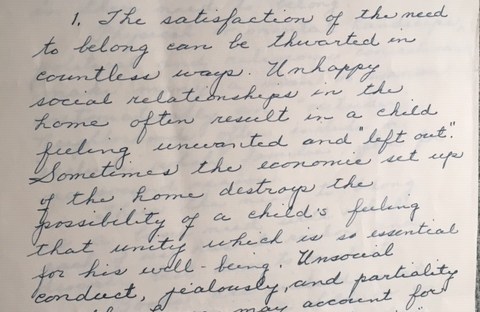
My Grandmother was a teacher (and a nurse) in Lewiston, Maine, sometime in the 1920s-1940s. She’s the older woman with a turban in the picture below; I am the baby. This picture was taken on her last trip to California from Maine, soon after she passed away (to give context on her height, my mom, in the center of the photo, is 5ft 5in). My grandmother, Fern Stanton, taught in a one room school house, an array of ages and subjects. She was in her 75 when she passed away in 1981. I didn’t know her well, since I was so young when she passed away. She was such a small woman when she died, and yet so dynamic throughout her life.
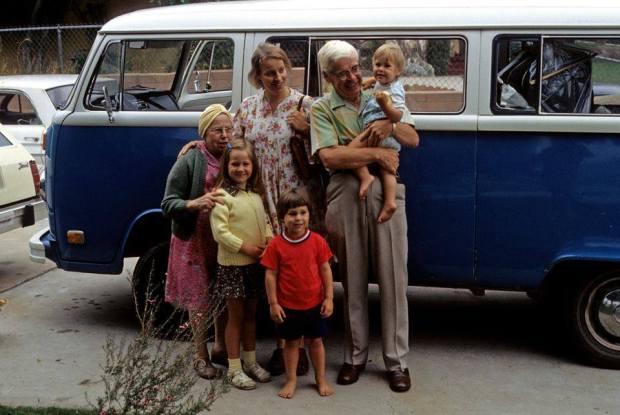
When I became a reading teacher, my mom passed on her old college papers to me. These papers were probably written in 1923-1924 (the dates are thanks to my sister’s sleuthing) when she was in college for teaching in Defiance, Ohio. Her essays are always a kick to look at, since they are handwritten close to 100 years ago. As a reading specialist, I think her ideas resonate pretty well almost a century later, even though her word choice is dated. Nothing is new under the sun.
In sharing this essay of my grandmother’s, I reflect on who I am and how ideas and values are passed down generation after generation, even without us knowing. I fell into being a reading specialist well before I knew, and read, my grandmother’s perspectives on teaching reading. And I am left to wonder, did I really fall into my profession, or was it passed down through countless library trips and read alouds on my moms lap, an inheritance from her mother- exactly the thesis of her paper.
The Teaching of Literature in Elementary School
Written by Fern Stanton (sometime during 1923-1924)
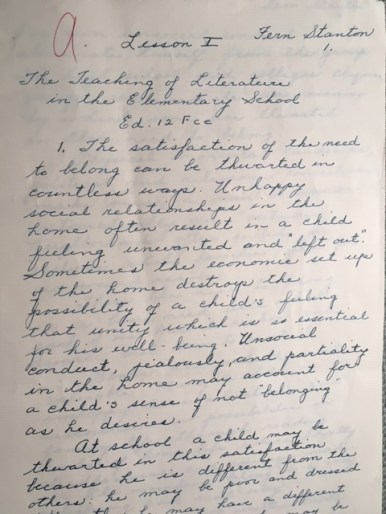
The satisfaction of the need to belong can be thwarted in countless ways. Unhappy social relationships in the home often result in a child feeling unwanted and “left out”. Sometimes the economic set up of the home destroys the possibility of a child’s feeling that unity is so essential for his well-being. Unsocial conduct, jealousy, and partiality in the home may account for a child’s sense of not “belonging” as he desires.
At school a child may be thwarted in this satisfaction because he is different from the others: he may poor and dressed differently; he may have a different cultural background; he may be just a “foreigner”; or he may by his own unsocial conduct eliminate himself from the group. In high school and college cliques, gangs, sororities etc. are means by which some are thwarted in their need to belong.
Physical or mental handicaps, political and religious convictions make many a man or woman automatically and “outsider”. Neighborhoods often “include” or “exclude” whole families, often for no sound reason.
Thus the need to belong is a basic need with which each of us has to reckon and discover best how to meet it.
Books are indeed most valuable. Many a child in an unhappy home situation, has discovered new possibilities in family life through reading books of home-life where loyalty steadfastness and courage makes all the members “belong” in a very satisfying way.
There are well written books of school life in which the shy child, or the poor child, or the child of a minority group overcomes difficulties and wins a respected place. Such books help in two ways: first, the child himself (or adult) may gain a better insight into his own problem of feeling “left out” and so work out a solution; and second, often those who are guilty of preventing others from experiencing a truly satisfying fulfillment of the need to belong may through reading gain a new understanding of people and learn to feel with them and thus become more friendly. Books help us to understand and feel with people. When we understand a person, we usually want to him to feel he belongs.
There are four kinds of security we all need: material, emotional, spiritual, and intellectual.
The fairy tales of old were designed to satisfy a need for economic security and we find this motif present in many stories of pioneer life and biographies.
Perhaps the “famous cycle of stories about the often-endangered Ingalls family, by Laura Wilder” satisfies the need for emotional security and enables the child to build those elements of love, fortitude and gaiety into his pattern for family life.
There are many who find comfort and spiritual security in the great events recorded in the Bible. Bunyan’s, Pilgrim’s Progress has no doubt influenced the thought of many who longed for spiritual security. There is today excellent children’s encyclopedias, as well as many accurate books on almost any subject, designed to develop and satisfy the drive for intellectual security.
“Reading for escape” becomes a sensible measure of safety when it means pausing to catch our breath during a hard climb or beating a hasty retreat before outrushing a truck. Sometimes when pressures bear down upon us too heavily, reading may create for us a little oasis of safety and quiet, where we can relax, learn how to laugh again, and step forth with renewed courage.
“Reading for escape” is reprehensible if it means cowardly running away from responsibility, or an unwillingness to face reality. It is dangerous if we choose reading that gives us a “false idea of life.”
In the book Caddie Woodlawn there seems to me to be several basic needs satisfied. For instance the Woodlawn family chose a modest, independent, economic security rather than accept the uncertain pleasures of an estate in England. It is not this the thing that we us Americans find satisfying our need for Economic Security – labor well spent with freedom?
Hetty, “who must always tell first,” reveals the struggle of one who overcame and finally won her coveted place in the affection of Caddie, her need to “belong” finding fulfillment and Caddie’s need to love experiencing new vistas.
The family loyalty and warmth of devotion in the face of discouragement – even to the extent of having turkey meat everyday – as a satisfying conclusion of the vote in the family Bible leaves us happy and content, knowing that life is or can be so. What better evidence of emotional security?
Teachers and parents have extremely important role in the helping children develop a good taste in Reading.
In the first place, they must set good examples of themselves. This has particular application to parents. The child whose parent chooses good reading, and has only good material available in the home is likely to learn to appreciate those books in time. This is especially true if from babyhood days the parent or parents share the delightful experiences with books with the child. To read aloud the stories is a source of enjoyment young and old can share alike. Thus the teacher or parent can make a story full of meaning if she reads it well. What teacher has not heard, “I like it when you read it.”?
Parents and teachers ought to encourage children to tell about the incidents they found especially interesting. Too often this natural outcome of reading is discouraged by insincere intention on the part of the listener. Bye “talking over” books often the adult has the opportunity to suggest other books which might help the child to develop his taste for good reading.
Teachers and parents need to know their children, to discover what basic needs must be satisfied and so be prepared to recommend suitable books.
A child should have books of various kinds available. He should have a place for his very own book so that he may be free to use them as he feels the need. Trips to the bookstore and Library can be confusing but properly directed may open the door of good reading for the child. Thus parents and teachers must weigh the kinds of literature available for children, and then try to determine how they can help them discover the pleasures of reading books that are genuine books of art instead of books that are second-rate or poor.
Well said, Fern. Do her ideas still resonate today? And what is dated, inaccurate or inappropriate?
I agree that belonging is core to human need. How can we foster a community of belonging with and through books in our classrooms, communities, and homes?
 learning made local